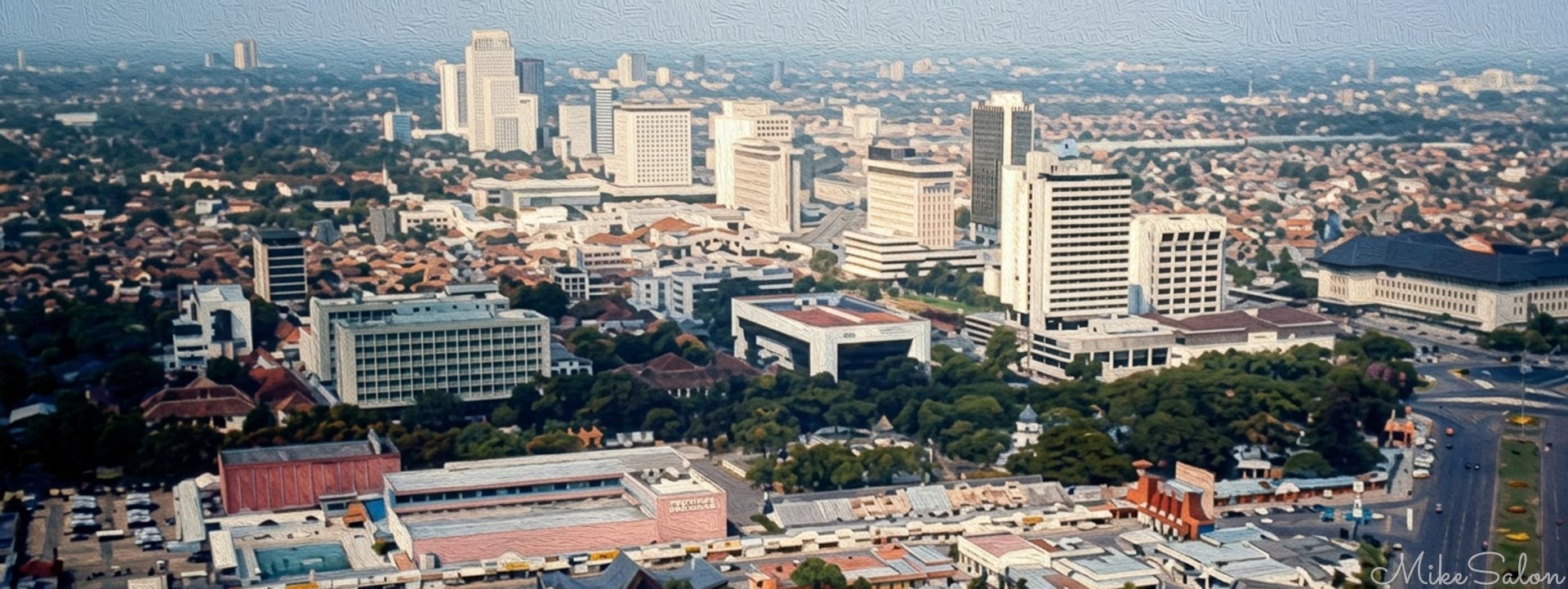
When I worked there in 1981, Indonesia was a country still close enough to its turbulent past for the memories to feel recent. Only 16 years had passed since the upheaval of 1965 — the period later immortalised as The Year of Living Dangerously. In Jakarta, people didn’t speak of it often, but the atmosphere carried a sense of a nation that had steadied itself after a near‑fracture. By the time I arrived, the New Order government had imposed stability, and the country was pushing forward with a confidence that belied how recently it had stood on the edge of chaos. From a photographic point of view, the scenes of old Jakarta were the most promising, but it is also true that some of these were going to pay the price of modernisation.
Indonesia's Independence
When you stand in Merdeka Square, you’re standing on the emotional ground zero of Indonesia's national story. The word Merdeka — “freedom, independence, liberation” — is woven into the country’s identity, shouted in parades, etched into monuments, and carried in memory by those who lived through the struggle.
After Japan’s surrender in August 1945, Sukarno and Mohammad Hatta seized a narrow window of possibility and proclaimed Indonesia’s independence on 17 August 1945. The Dutch refused to accept it, and what followed was four years of upheaval: guerrilla warfare, diplomatic standoffs, and immense civilian sacrifice. It was only in December 1949, under international pressure, that the Netherlands formally recognised the new republic.
Monas — the National Monument — rises from Merdeka Square as a physical embodiment of that journey. Its marble base and gilded flame commemorate the trauma, determination, and unity that shaped the nation. The surrounding civic buildings, statues, and broad avenues were designed to anchor Jakarta's identity as the capital of a modern, independent Indonesia.
This square is not just a landmark; it’s a reminder that the city’s rapid growth stands on the foundations of a hard‑won freedom.
The Development Boom...
The Indonesia I saw in 1981 was driven by forward momentum. The company I was working for was just one example. Jakarta was expanding, modernising, and industrialising at a pace that was obviously ambitious and visibly uneven. The city's skyline was still modest, its infrastructure stretched, and its humble riverside cowering in the shadow of modernisation. There were signs of change everywhere: new factories, new roads, new offices, and a growing sense that Indonesia was preparing itself for a larger role in the region. For a visitor, the country felt young, determined, and full of possibility.
The decades since have transformed Indonesia beyond anything I could have imagined at the time. The skyline has risen, the economy has diversified, democracy has taken root, and a vast middle class has emerged. When I returned briefly in the mid‑1990s on business — not to revisit the company I had worked with, but on other matters — the pace of progress was unmistakable. The city I had known had accelerated into a new era: taller, busier, more confident, and already well on its way to becoming the metropolis it is today. Yet beneath all that change, the same qualities endured: resilience, warmth, pride, and a national character shaped by history but not defined by it.
As I read it, Indonesia today sits in the grey zone between "developing" and "developed": no longer poor, not yet rich, and moving steadily upward. In 1981, it was still firmly classed as a developing country — which is precisely why the steel‑processing technology we were introducing had been designed for nations at that stage of growth. Indonesia has since become an upper‑middle‑income economy with strong industrial capacity, but in those years it was still climbing, still building, still finding its modern footing.
This statue depicts the hero Arjuna in the Mahabharata, a mythological Indian epic, which came into Java when Hindu culture flowed into the Indonesian archipelago more than a millennium ago. It is mythological in form, yet has historical influences. Archaeological and linguistic evidence suggests that some of its settings and customs reflect genuine historical realities. Over time, Javanese and Balinese storytellers absorbed the epic into their own traditions, retelling it through classic Indonesian shadow theatre, court literature, and public monuments. Heroes like Arjuna became symbols of courage, discipline, and moral clarity because they expressed ideals that resonated across centuries.
Expat Life, lots of work, some play...
As Aussie expats stationed for long periods in Indonesia, we were very well treated, a credit to our local hosts, and to our company bigwigs who negotiated such good conditions. For short stays, we were housed in luxurious hotels. For multiple month sojourns, we lived in 3 or 4 bedroom bungalows which embraced the best of comforts the city could offer. If we weren't going someplace for dinner, all meals were prepared by live-in housekeepers who of course also cleaned maintained the property. Our bungalow had a swimming pool, and being in the tropics, was designed to be opened to the warm weather, or air-conditioned when it got too hot. This was Jakarta in the 1980's, so our bungalows were very secure in walled, gated compounds, complete with guards.
We never drove. We had access to company cars with assigned drivers who would take us to and from work at any time, and also to any engagements we had outside the factory. My bungalow was in South Jakarta as I recall (although I cannot place it on a current map) and the plant was about 20km away to the east. There's no trouble find that on the map! The drive was depressing, with overcrowding and poverty evident everywhere - I learned to read a book in the passenger seat. I hope, as Indonesia becomes more wealthy, scenes like that are now less common, and the roads are bound to be better too!
Work hours were long: once the plant got started in production, a small Aussie team had to cover supervision 24/7 for about 3 months. Outside of work hours, it was a good life. Company staff and line technicians were rostered (no doubt) to entertain us frequently. We enjoyed meals out frequently, as well as visits to local attractions, and on weekends, when commissioning had settled down, we were able to go further afield. In my case, I played tennis with some of the senior line technicians, an activity sponsored by their company. I was no match for these well-trained locals.
We were single men (all men) on duty in Jakarta, but various family members visited us for a week or so here and there. This gave us to showcase Jakarta to them, generally warts and all. My wife and son came and thoroughly enjoyed their time in Indonesia, and absorbed the experience in ways which will bed down in their memories.
This capture is one of my favourite portraits. AI has elevated it from a bedraggled 35mm slide to what I regard as an oil painted near-masterpiece. This weathered gentleman obviously agreed to me taking his photograph, and from the angle it looks as though he was taking me somewhere in his boat. I really cannot recall the circumstances, but his aged face, classic pose, fine moustache and prominent cigarette have elevated this portrait to one of my best!
The Production Crew, a fine team...
The photographs below capture more than a team — they record a moment of shared purpose between Indonesian technicians and Australian engineers during the commissioning of a new steel‑processing plant in Jakarta. Face reflect a pride of mastery, the patience of training, and the camaraderie that forms when people work side by side toward some lasting goal.
The Indonesians shown here were quick learners and dedicated operators, taking ownership of complex machinery with confidence and care. The Australians who trained them brought technical expertise and a spirit of mentorship that shaped the workshop floor. Halfway through the project, it became clear that communication had grown into a two‑way exchange: the crew weren’t just learning the plant — they were learning English, too. Their speech began to carry the rhythm and idiom of Australia, a quiet echo of the trust and humour shared across the long days of commissioning.
I tried to meet them halfway, picking up enough Bahasa Indonesia to get by — half capable, never fluent, but able to share a joke or a simple instruction. It didn’t sink in very far: fifty years later almost all of it has faded. Yet the memory of those conversations remains vivid, because language was never the real bridge. The real connection came from shared work, shared effort, and shared respect.
That connection endured long after the project ended. Some thirty‑five years later, several of the senior Indonesian crew — by then company executives — travelled to Australia on business. They went to the trouble of looking me up in Sydney and hosted me for a lavish dinner in Chinatown. I was overwhelmed by their warmth, their gratitude, and the simple fact that they remembered. It was a reminder that bonds forged in the heat and noise of the plant had lasted across decades and oceans.
Together we built not only a functioning plant but a bond of professional pride and friendship. Half a century later, many of these men are gone, and those who remain would be well into their senior years. This page stands as a tribute — to their skill, their teamwork, and the enduring human connection forged in the rhythm of industrial progress.
A Rant, for my final words...
I feel that Australia has long underestimated the significance of Indonesia sitting just across the Arafura Sea, our largest near neighbour — a nation of 280M people, spread across more than 17,000 islands. Look at a map - those islands are a vast buffer between Australia and the wider world, a natural shield whose strategic value we rarely acknowledge. The islands make it one of the countries most exposed to climate change, a global reality that receives not much more than lip-service in Australian politics.
Indonesia remains oddly peripheral in Australia's national consciousness. Indonesian language programs were trendy for a while, but have dwindled in our schools and universities. Media coverage tends to appear only when tragedy strikes. This neglect is a clear denial of Indonesia’s growing weight: its economy is now the 16th‑largest globally, heading for the top ten. (Australia sits around 13th.) Indonesia is becoming one of the engines of the Indo‑Pacific. Yet we neglect it at our peril.
Indonesia is predominantly Muslim but it is nation that tolerates and protects multiple faiths on a daily basis. In that sense, it mirrors Australia's own multicultural character more closely than we accept. And by my own lived experience, Indonesians are warm, open, and generous. Not only that, the diaspora in Australia is growing, contributing across business, academia, hospitality, and the arts. These are the foundations of a relationship that could be far deeper than it is today.
Consider this too: AUKUS may be controversial at home, but it should not be seen as a threat in Jakarta. If we framed it properly, it could be taken as part of a broader effort to maintain stability in the region, benefiting Indonesia as much as Australia. Partnership, not suspicion, is what we need.
If Australia wants a secure, prosperous future in the Indo‑Pacific, it must treat Indonesia not as an occasional headline but as a central partner to be cherished and nurtured. The opportunity is immense, our interests are aligned, and the goodwill is already there. All that's missing is the seriousness of intent, from both our politicians and also our business leaders, most of whom seem blind to the opportunity.