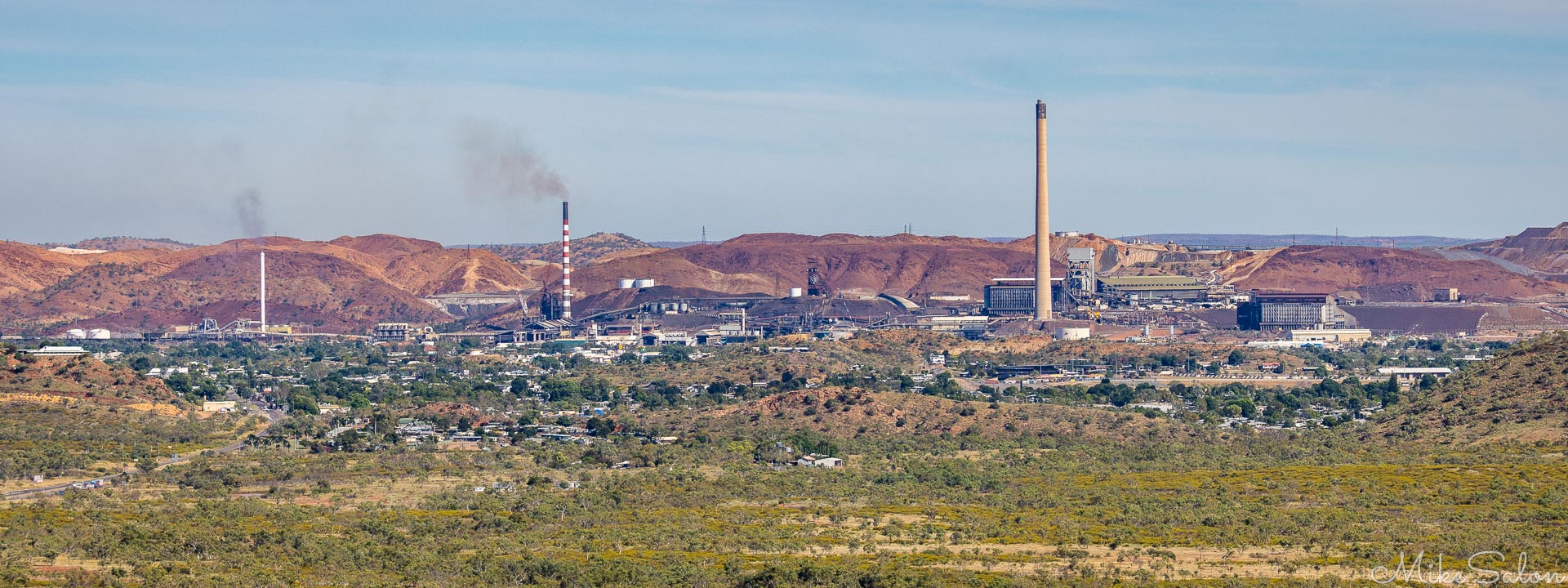

Perched on the rugged edge of the Selwyn Range in Queensland’s vast north-west, Mount Isa is a striking testament to human grit and industrial ambition carved into the ancient red dirt. Located over 800km from the nearest coast, "The Isa" is one of the most geographically isolated cities in the world, yet it beats with a global economic pulse. It is a city defined by dualities: a place where the colossal, smoke-belching stacks of its world-class copper, lead, and zinc mines pierce the outback sky, operating alongside a transient Fly-In, Fly-Out (FIFO) workforce that keeps the town in a state of perpetual motion. But beyond the relentless machinery and the shift-work rhythms of the mining industry lies a surprisingly vibrant natural sanctuary. Just minutes from the industrial core, the serene waters of Lake Moondarra offer a stark, beautiful contrast—a thriving oasis that plays host to a spectacular array of native birdlife, from elegant pelicans to darting honeyeaters. Here is a community built on a massive mineral boom, surviving in utter isolation, and framed by an unexpected, wild beauty that flourishes in the shadow of the mining headframes.
The city of Mt Isa, known as The Isa, sits in a semi-arid tropical zone north of the roughly east-west Selwyn Range in outback Queensland. North of the Range, its rivers flow north into the Gulf of Carpentaria. Because they rely almost entirely on the northern summer monsoon (the top-end wet season), these rivers are classic "ephemeral" streams. Once the monsoon recedes in March, they rapidly stop flowing and shrink back into isolated waterholes, leaving a dry sandy bed, which is what we saw in the Leichhardt River in May and June, barely more than a series of brown puddles. South of the range, Channel Country (the subject of another blog post) which drains into Lake Eyre, it's a different world. The stagnant Leichhardt River doesn't discourage birdlife, and walking along its dusty banks, it was easy to espy a good range, and some fauna even posed for photographs.
The town itself is a large example typical of the Queensland outback. A few pubs and a club (Buffs) which idle during the day but come alive in the evening, generally wide streets, a high street with a variety of shops etc. Generally quiet, especially on weekends, but the limited activity is bolstered by the mining activity nearby. Road trains roar through the town on the main roads. Well marked mine utes with big identifying numbers and, often, visibility flags,patrol the town. Mt Isa has a couple of supermarkets that smaller towns lack. An excellent visitor information, Outback Isa is on the site of a tourist mine.
Every August, the town hosts the Mount Isa Mines Rodeo at Buchanan Park. It is officially the largest and richest rodeo in the Southern Hemisphere. For four days, the remote mining hub more than doubles in size as over 25,000 spectators and roughly 750 elite competitors from across Australia and overseas flood into town. We weren't here for that, this time, but think it would be a fantastic photographic opportunity.
Mount Isa Mines, the pulse of the town...
Mount Isa Mines (MIM) began operations in 1924, after the discovery of rich lead-silver-zinc ore bodies. Today, the complex is owned by Swiss-based Glencore. The site includes both underground and open-cut operations, producing copper, lead, silver, and zinc — all extracted from the same geological formation known as the Mount Isa Inlier, a Proterozoic deposit over 1.6 billion years old.
The skyline is dominated by three towering stacks. The Copper Smelter Stack, the tallest, at 270m, was built in 1978 and is one of the highest structures in the Southern Hemisphere. The others are the Lead Smelter Stack and the Power Station Stack. Together, they symbolise Mount Isa's industrial might and are visible for kilometres across the outback. Products are shipped 900km by rail to Townsville. Concentrates and refined metals are exported globally, mainly to Asia and Europe.
Mt Isa's workforce is a mix of local residents and FIFO (fly-in, fly-out) workers. This was evident by the crowds we saw at the airport. The city retains a strong permanent mining community. Glencore supports housing, training, and apprenticeships locally, helping sustain the town's population of around 18,000.
When MIM ended its underground tours in the late 1990s for safety and operational reasons, the city wanted to preserve that experience for travellers. The Queensland government, local council, tourism operators, and Mount Isa Mines collaborated to create a replica underground mine, complete with authentic equipment, tunnels, and guided tours led by retired miners. Photography was not permitted here, so we didn't go. Other underground mine tours are happy with cameras, but not this one!
Lookouts, hither and yon, but closed...
Mt. Isa is a city blessed with three lookouts, all to the east, so they show the town (and the mines which dominate it) in good light in the mornings. All three are strangely inaccessible. Mt Isa Lookout, closest to the CBD, is totally fenced off. The other two are closed to public vehicular traffic, but are open to pedestrians. These are Ray Donaldson Memorial at the top of Pamela St and Telstra Hill, about 7km towards Cloncurry. Visits (well climbs, really) to both these lookouts proved worthwhile.
Moondarra Lake, the oasis of the city...
Lake Moondarra north of the city is an artificial reservoir created by a massive engineering project completely tied to the Leichhardt River and Mt. Isa's survival. Completed in 1958 by Mount Isa Mines (MIM), the dam was built specifically to secure a reliable, permanent water supply for both the rapidly expanding industrial mining operations and the growing township. Before its construction, water scarcity was a severe threat to the viability of the remote outpost. Today, it supplies water to the Mt Isa and the processing plants, while doubling as the region's premier recreational hub for swimming, boating, and barramundi fishing. Rather tam e peacocks strut around the picnic areas looking for scraps, and other birdlife can be seen near the edges of the lake. We visited there twice during our stays in Mt Isa.
Mary Kathleen, the million pound discovery...
Mary Kathleen's history kicked off in August 1954 when a small syndicate of local Mount Isa prospectors detected massive radioactivity in the rugged Selwyn Ranges. Mary Kathleen (one of the prospector's late wife), mining giant Rio Tinto took charge, securing a lucrative contract to supply uranium oxide to the United Kingdom Atomic Energy Authority until 1963, shipping over 4000t. Because the deposit sat in an incredibly harsh, remote environment, the company built an entire, state-of-the-art township from scratch to attract workers. Completed in the late 1950s, Mary Kathleen township became celebrated as a lush, master-planned oasis, featuring a cinema and an Olympic pool. From 1976, rising global demand triggered a second lease on life, another 4000t of "yellow cake" was shipped, but it was closed for good in 1982. All that is left are concrete slabs, street curbing, and the vibrant, chemical-blue waters of the abandoned open-cut pit against the red outback soil. The old township was populated only with caravanners when we visited, while the 9km track to that spectacular pit was longer and much worse than anticipated, but our mighty Suzuki Jimny handled it with aplomb. There is a Mary Kathleen Memorial Park and Museum and Information Centre in Cloncurry which we did not visit.
Accommodation in Mt Isa, tale of two hotels...
We had the opportunity to stay in two different accommodations in Mt Isa. Both were perfectly adequate, but other differences were stark and maybe unexpected. The Ibis Styles Hotel is a modernish four storey establishment on Rodeo Drive in the city, with all the amenities expected. It seemed to have very few guests on two occasions we were there, and indeed the reception desk rarely had anyone in attendance. A very quiet place indeed. Our shower here was a 'climb into the bathtub' type, but otherwise, no compalints. We also stayed twice at the Abacus Motel, a traditional single storey L-shaped model closer to the airport than the CBD. The Abacus was as you'd expect for a refurbished 1960's motel, fine but plain. Both rooms we had had a walk in shower which leaked onto the bathroom floor as soon as you turned the taps on. But it was well patronised with tradesmen and FIFOs. Its popularity was possibly due to guests being able to park at their door, and for friends to congregate informally (after work we suppose) for socialising. Some guests felt it was too far out of town, certainly more than a short walk in And it was noisy, air conditioners roaring outside the bathroom window and the road trains being just a little bit too close. Neither hotel was keen on early check-ins, but that is to be expected.
Footnote, my admission of truth ...
The captions and titles on the images are mine, and I take responsibility for them. But I'm no naturalist, so the identification and descriptions of fauna and flora mostly comes from sources like local guides, Wikipedia, e-Bird, Merlin or artificial intelligence agents like Gemini or Copilot. It is fabulous to have those resources available!