Aussie Places
Balranald, and Yanga Station...
August 2025
Balranald, located in the Riverina area of western NSW, is a town with a rich history and a unique landscape. It`s often referred to as the `gateway to Outback NSW.` In the mid-19th century, Balranald wasonce an important river port and crossing point for livestock. Five major rivers (Murrumbidgee, Murray, Wakool, Edward, and Lachlan) all meander through the area, only obvious from a map. Balranald is a popular destination for fishing, boating, and bird-watching. It serves as a base for exploring significant natural and historical sites, including Yanga National Park. For us, Balranald was a pleasant town for a rest stop, and a worthwhile visit to the old sheepstation of Yanga. Like many other places, Balaranald would be worth more time than we gave it.
This 2013 swing bridge crosses the Murrumbidgee River and leads to the Ben Scott Memorial Bird Trail. [4925]
Who Ben Scott was, we could not find out. While the name is used for these significant local landmarks and projects, there is no information as to who Ben Scott was as an individual, his life, or why these places were named in his memory. [4927]
The slow-flowing Murrumbidgee River as it passes through Balranald. Tannins from decomposing organic matter and suspended silt, clay and mud result in its characteristic murky brown appearance. Land clearing and erosion, and irrigation systems, make it worse. [4926]
Part of the 2.4km Bidgee Nature Walk on the other side of the river to Balranald. Local website says `keep an eye out for Yellow Rosellas, kookaburras and the occasional echidna, not forgetting kangaroos and emus` but we saw none of those. [4931]
Visitor Centre, jail and experiences...
We didn`t want to spend too much time in Balranald, being just a whistle stop on the day`s journey. We called into the Visitors` Centre, found a cafe there, and a few other things to make the experience worthwhile. The lady behind the counter, surely a volunteer, was most helpful, and lent us a key to open the jail door. Inside we found a giant frog looking like a rock-star - see photo captions for more information! On the same site was an award-winning Interpretative Pavillion, well worth the walk through, and the Wintong School, a tiny hut which once served as station homestead.
Impressive scrap metal statue of what we believe to be a wedge-tailed eagle at a nest, as seen at the Balranald Visitors` Centre. [4937]
Learning about the district at the Balranald Visitor Centre. [4951]
Sheep going through the gate at the `shearing shed` at Balranand Experience Centre. [4948]
A member of the yucca family, this seems to be an agave attenuata, also called foxtail, lion`s tail or swan`s neck. Whatever it is, it looked great inBalranald. [4953]
With strict instructions to bring it back, we picked up the key to the Old Balranald Gaol at the Visitors` Centre and entered through this door. [4941]
Funky Frogs which can be seen all over Balranald remind us of the endangered Southern Bell Frog which is disappearing from the area. This rocker is performing in what we assume to be the jail`s excercise yard. [4942]
This tiny 1886 building was originally the homestead on Wintong Station. It later became a schoolhouse as well as the teacher`s living quarters. Relocated to the Balranald Visitor Centre in 1995. [4944]
Yanga Station
The huge Yanga Station, on the banks of the Murrumbidgee, was once one of one of the largest in the southern hemisphere, and thanks to its acquisition by the NSW National Parks and Wildlife Service in 2005, it is now preserved. We spent more time here than in Balranald itself, about 2-3km away. Highlights are a huge woolshed and the 1870 homestead (which is in very good condition compared to some we have seen) and has a rose garden maintained by volunteers and very pleasant views over Yanga Lake. Camping is possible in this National Park, but you are warned to be `self-contained`, not even water is available. The original woolshed here was destroyed by fire in 1896 during an industrial dispute. The shed that we have photographed was built in the 1900`s. Its over 100m long and could shelter 3000 sheep. A fascinating and extensive 1923 article from The Australasian newspaper, found in Trove, that fabulous resource, describes Yanga Station. Here`s an excerpt: Right through Dr. Williamson`s time, which extended till 1875, Yanga was a cattle run. One can readily understand that it was grand fattening country, as the flats and areas liable to flooding were then, and still are, very considerable. Sheep do not appear to have been introduced until after Mr.Fisher purchased the property in 1875, and then the sheep which were brought here are stated to have been English Leicesters. But it was during Mr. Fisher`s regime that merinoes wore introduced.
Historical map showing the vast size of Yanga Station and its strategic frontage on two rivers. Note: no roads shown, and no state boundaries. [4969]
Signage at the entrance to the homestead at Yanga National Park. [4989]
Tranquil and beautiful, Yanga Lake in front of the old sheep-station homestead. [4977]
Yanga Homestead seen here fronted by its rose garden. [4979]
Yanga Homestead uses a `drop log` construction method. Maybe that`s what you can see here? [4982]
Yanga Homestead uses a `drop log` construction method. Maybe that`s what you can see here? [4980]
We`re not sure, but we think these are cherry blossoms, but it`s still mid-winter? [4973]
The citrus trees are growing at the Yanga Homestead. [4976]
Thought to be home-made and date to the 1930`s, corrugated iron canoes were commonly used on Yanga Lake. [4986]
Showing the Yanga Woolshed with the trees on the banks of the Murrumbidgee River behind it. [4959]
An old woolshed kept in magnificent condition in the care of the NPWS. The Murrumbidgee River curves around at the top right. The buildings to the left include mess huts, washrooms and quarters for experts, shearers, woolclassers. [0060]
Corrals and pens for managing the incoming sheep at Yanga Woolshed. [4966]
Walling at Yanga Woolshed. The nailholes imply extensive reuse of this sheeting. [4963]
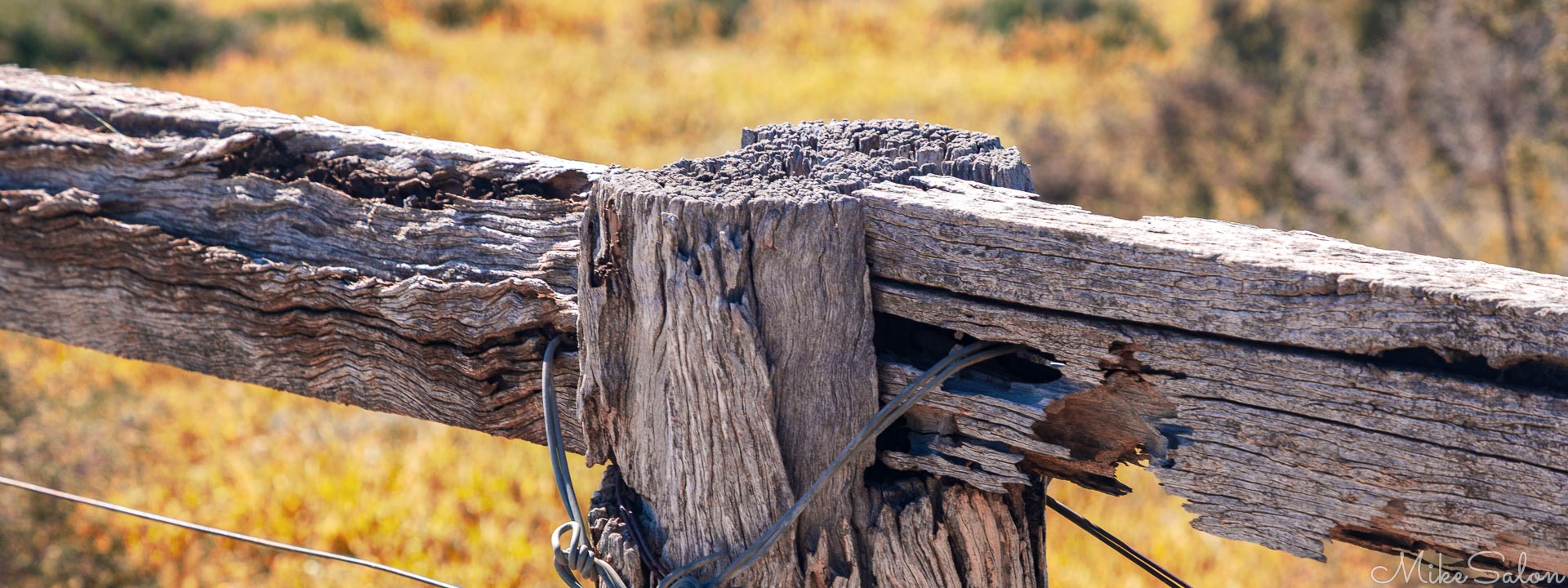
Detail of post, rail and steel wire in this Yanga Station fence. [4958]