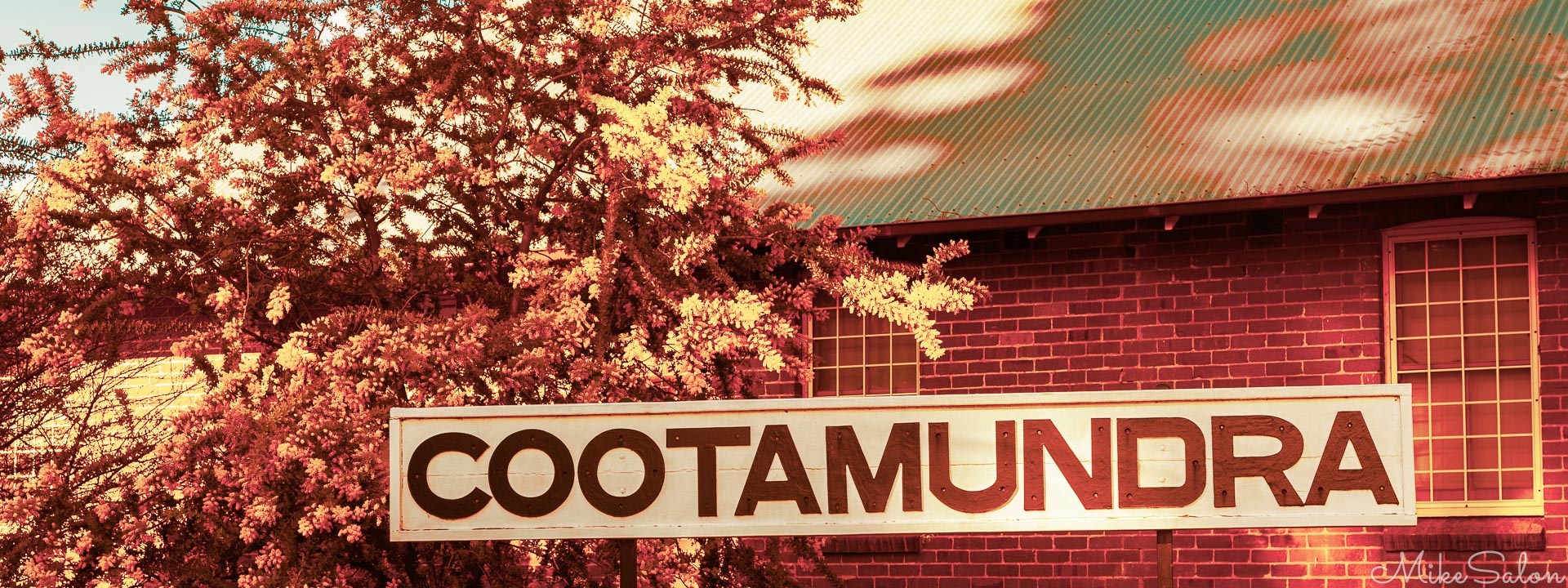

Cootamundra (pop 6-7,000), affectionately abbreviated to `Coota` as required in Aussie English, is a charming rural town nestled in the south west of NSW, within the fertile Riverina region. Founded in 1830 as a livestock station and proclaimed a township in 1861. Positioned roughly halfway between Sydney and Melbourne, but not on the main freeway joining the two cities) and less than two hours from Canberra, Cootamundra occupies a strategic spot on a principal rail corridor. Much of its character derives from agriculture: historically a hub for sheep, wheat, canola, and wool production, with recent diversification into olives, almonds, pistachios etc. More famously, Coota is the birthplace of cricketing legend, `our` Don Bradman. Cootamundra promises warm country hospitality, deep-rooted heritage, agricultural vitality, and a dash of sporting history all within a picturesque regional setting. We chose to come here simply because we had not been here before! The traditional owners of the country around Coota are the Wiradjuri people, and the town name probably comes from their word for `turtle`.
Coota the township...
It was cold and drizzly during our visit, and we had to duck and dive to keep dry. Cootamundra seems to have a larger CBD than its population would indicate, stretching mostly along Parker Street. It`s a tidy CBD, decorated by fairy lights in the trees at night, a good sign of civic pride. As in other country towns, there are rather too many empty shops. Some advertised cafes seem to be closed permanently, but we enjoyed breakfasts and good coffee at La Crema Cusina, a place recommended to us by a helpful patron at the Albion Hotel. We had dinner at the Albion one night - its renovation is pleasing, modern, clean-cut and bright, surely a world apart from what it must have been. There is a huge beer garden out the back. The accommodation at the Albion has been updated too, and we could see that it has a number of in-house guests.
The Cootamundra Railway Station, a heritage-listed site, opened in 1877 as a part of the Main Southern Line extension from Harden. It quickly became a crucial junction for several branch lines, including the Tumut and Kunama lines, which opened in 1886. This network of lines connected Cootamundra to a wider agricultural region, reinforcing its role as a hub for both passenger and freight services.The town`s railway yards included a locomotive depot and extensive marshalling yards. Today, Cootamundra`s railway is still active, though the extensive passenger services of the past have been largely replaced by other forms of transport, but the station remains a vital link for regional travel. It is served by NSW TrainLink's XPT and Xplorer services, providing a daily passenger connection to both Sydney and Melbourne on the main line, and a twice-weekly service to Griffith on the branch line. Coach services also operate from the station, connecting to a wider network. On two occasions we arrived at the station to see one of these scheduled trains only to find dispirited passengers in the waiting room, and announcements that the train was an hour or more late. No wonder people drive or fly! Coota is also a major freight hub, particularly for grain traffic. The railway line between Cootamundra and Stockinbingal is a part of the broader Barnaby Joyce`s pet project, the Inland Rail, to create a dedicated freight corridor between Melbourne and Brisbane, bypassing Sydney.
You can tell when a hotel or motel is penny pinching. The first sign is toilet paper more like tissue paper. We stayed at the single storey Southern Comfort Motor Inn which, thankfully, used good solid Sorbent Luxury 3 Ply. The bathroom had an opening window too! This white brick motel comes from the 1980`s, and was configured in an L shape embracing a large parking area. It`s dated but well cared for. A new leaseholder has only taken over a month ago and suffered the misfortune of a customer forgetting he was towing a horse trailer and partially demolished the porte cochere which should have been built a meter taller in the first place. The repair in progress made the entrance look untidy, but that will pass. The very friendly host at SCMI recommended dining and breakfast options in Coota which we followed.
Bird Walk of Muttama Creek
In advance, we didn`t think of Coota as a bird-watching destination, but it proved to be quite good in this respect, despite not very good weather. We learned that Coota`s location in the South West Slopes region of NSW gives it a diverse mix of birdlife, blending species common to agricultural lands and woodland habitats. It's a temperate zone away from the coast but far from the outback, and it supports a variety of birds. The town itself has a dedicated, rather short, Bird Walk along the rather uninspiring but nevertheless flowing Muttama Creek, and we walked it back and forth in light rain where we discovered a number of rather photo-shy varieties that may be less common elsewhere.
The World`s Greatest Batsman...
The legendary cricket batsman, still considered to be the world`s best ever, was born in the house of a midwife in Cootamundra in 1909. His family lived in Yeo Yeo. With Don two years old, the family moved to Bowral to seek better opportunities, particularly for the children`s education and access to services. It was in Bowral that Bradman grew up, developed his cricket skills, and famously practiced by hitting a golf ball against a water tank with a cricket stump, a key part of his legendary origin story. But Cootamundra remains his birthplace, and the town is not going to let that go. The birthing centre is now a museum (`you can stand in the room where the Don was born!`), staffed (for our visit) by a friendly volunteer called Betti who had warmed the museum up nicely and was entertained by her own choice of music, the daily paper and a good book.
Outside Cootamundra...
Just north of Coota is Wallendbeen (1853, `stony hill'), so named because of granite outcrops. The 1997 Milestone Sculptures in Wallendbeen, by artist Dawn Elrington, are a tribute to the significance of the wheat industry in the region, which has a history of producing high-quality, award-winning wheat crops. They are meant to resemble old milestones which preceded the kilometer era, and are made from cast concrete with patterns representing wheat stalks cut from compressed fibrous cement, painted in the soft color of wheat. The top of each sculpture features an acrylic panel inlaid with a motif of a large head of wheat. There`s a sample Milestone Sculpture in Cootmundra.
At Murrumburrah(twin town with Harden, `twin waterholes`) there is a captivating example of silo art by Heesco Khosnaran, a renowned Mongolian-Australian street artist. The art, painted on the former town Flour Mill, is a striking mural that tells the story of the region`s history, from its gold rush days to its prosperous agricultural heritage. The mural fully wraps the silos, depicting different facets of the town's history: farming, milling, prospecting etc.